


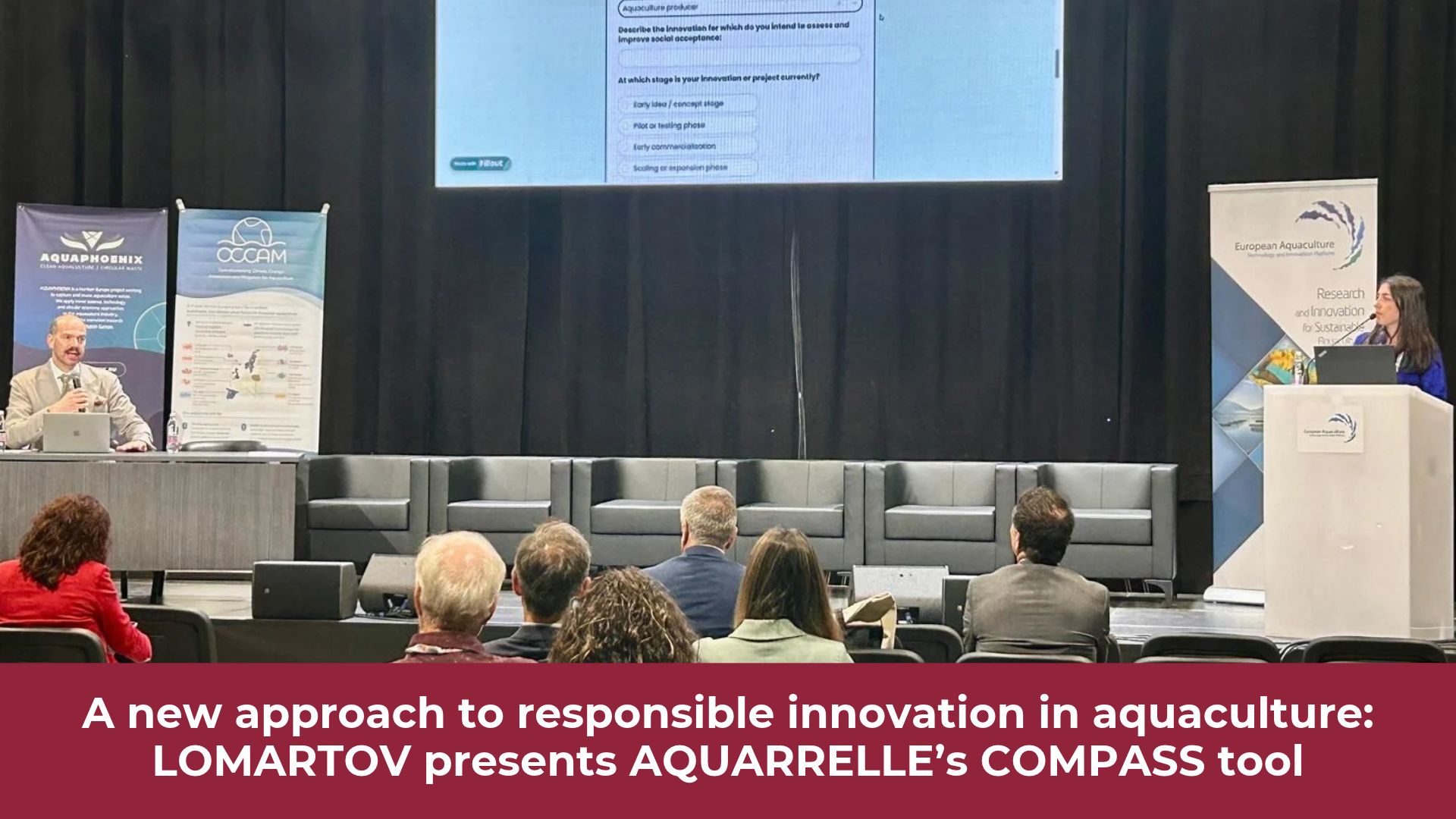
At the Innovation Forum of Aquaculture Europe 2026, LOMARTOV colleague Eleonora Ferrorelli presented AQUARRELLE’s work on Open and Responsible Research and Innovation (ORRI), including COMPASS, an online tool designed to help aquaculture organisations assess potential social risks and strengthen the acceptance of their innovations.
Bringing responsible innovation into aquaculture
Aquaculture is facing growing challenges as climate change affects food systems and production conditions. Research, innovation and knowledge transfer will play an important role in helping the sector respond to these changes. But developing new technologies and products is only part of the picture: understanding stakeholder perspectives and addressing societal concerns are also essential to their successful adoption.
This was one of the topics explored at the Innovation Forum during Aquaculture Europe 2026, where Eleonora Ferrorelli represented LOMARTOV in a session on Open and Responsible Research and Innovation (ORRI), alongside our partner EATiP (European Aquaculture Technology and Innovation Platform).
Held on 30 September 2026, the session focused on developing practical approaches to ORRI tailored to the aquaculture sector. Supported through the European REINFORCING project, the work aims to help research and innovation become more open, inclusive, transparent and responsive to society.
In practice, this means encouraging dialogue between researchers, businesses, policymakers, civil society and other stakeholders throughout the innovation process. By considering different perspectives from the outset, organisations can better anticipate concerns, understand societal needs and develop innovations with society, rather than simply for society.
Introducing COMPASS: a practical tool for responsible innovation
As part of the AQUARRELLE project, LOMARTOV and its partners are developing approaches to make ORRI principles more accessible and actionable for aquaculture stakeholders. One of these is COMPASS, an online tool that helps aquaculture organisations understand their current position, identify potential social risks and determine where they can improve the social readiness and acceptance of their innovations.
COMPASS is designed to support reflection and learning, rather than to impose a one-size-fits-all approach. It is not a compliance or certification tool, and it does not replace expert advice. Instead, it provides a structured way for organisations to assess their practices, identify potential vulnerabilities and consider practical improvements.
How does COMPASS work?
The tool guides users through four steps:
- Self-assessment: Users reflect on their organisation and innovation in context, considering areas such as stakeholder engagement, communication, transparency, environmental and social risks, governance and social licence.
- Tailored feedback: Based on users’ answers, COMPASS provides accessible explanations, practical examples and automatically generated feedback.
- Identifying vulnerabilities: Users can explore potential pressure points related to trust, stakeholder relationships and factors that may influence the acceptance of their innovations.
- Recommendations and action: The tool generates profiles and suggests recommendations and good-practice ideas that organisations can translate into practical actions.
Two modules to explore different aspects of acceptance
COMPASS includes two complementary modules:
- Innovation Acceptance Readiness evaluates how prepared an organisation and its innovation are to anticipate and address factors that may influence their acceptance.
- Social Licence Stress Test explores potential pressure points around trust, stakeholder relationships and social acceptance, helping users reflect on issues that could affect how an innovation is perceived by stakeholders and society.
Together, these modules offer organisations a structured starting point for considering the social dimensions of innovation alongside technical and environmental factors.
Help shape the future of COMPASS
The development of practical ORRI approaches depends on understanding the realities of the sector. Feedback from aquaculture practitioners is therefore important to ensure that COMPASS is relevant, useful and suited to the challenges organisations face in practice.
Aquaculture professionals interested in testing the tool are invited to explore COMPASS and get in touch with LOMARTOV to learn more about opportunities to contribute feedback. Their experience can help identify improvements and make the tool more useful for organisations working across the aquaculture value chain.
Working towards more inclusive and socially responsible aquaculture
Through AQUARRELLE, LOMARTOV is contributing to efforts to translate Open and Responsible Research and Innovation into practical approaches for the aquaculture sector. The project encourages organisations to consider not only whether an innovation works, but also how it responds to stakeholder expectations and societal needs.
By promoting reflection, engagement and continuous improvement, COMPASS aims to help aquaculture organisations better understand the social dimensions of innovation and make them part of the development process from an early stage.
